



How Modern Pest Control Tech Detects Vulnerabilities Before Infestations Begin
Imagine discovering a termite swarm just as it nibbles your foundation-too late, with thousands in repairs looming. You don’t have to wait for that nightmare. Modern technology in pest control spots cracks before bugs do, using sensors and AI in pest control to guard your home proactively with preventive measures. See how IoT networks and IoT devices, predictive analytics, and integrations like Orkin’s digital scouts detect infestations and fix weak points to stop them.
Evolution from Traditional to Tech-Driven Methods
People once controlled pests with wide-ranging pesticides like DDT. The EPA banned DDT in 1972. Today, traps from Terminix turn on only when they sense rodents.
This shift marks a broader evolution in pest management. Implement it through these actionable phases:
- **1950s Chemical Era**: Focus on quick-kill sprays like DDT for rapid results, but avoid due to environmental harm documented in Rachel Carson’s *Silent Spring* (1962), leading to wildlife die-offs.
- **1990s IPM Introduction**: Adopt Integrated Pest Management by monitoring infestations with sticky traps and using targeted baits, reducing chemical use by 50-70% per EPA studies.
- 2020s IoT growth: Use tools like Orkin’s AI cameras for real-time detection, reducing callbacks by 60% as reported in Pest Control Technology journal.
Real-world shifts include:
- Bayer’s agriculture tech in IPM farms yielding 30% less pesticide waste;
- Rentokil’s IoT sensors preventing 40% more outbreaks with non-toxic methods;
- and Terminix’s app integrations boosting efficacy by 55% for residential pest control and commercial pest control.
Propose a timeline chart to display adoption rates and industry patterns for client slides on pest control developments.
Importance of Proactive Vulnerability Detection
Proactive detection with tools like Flir thermal cameras spots termite damage early, preventing $5 billion in annual U.S. repairs as reported by the National Pest Management Association.
Cuts infestation costs by 80% per Terminix case studies for professional services.
You can spot risks before they get worse with tools like Flir thermal cameras for termites or K-9 detection dogs for bed bugs. These check walls and hidden spaces.
Key advantages include:
- Saves time, reducing detection from weeks of manual inspections to days with thermal imaging.
- Reduces health risks; for instance, early bed bug spotting prevents disease vectors, as CDC reports note potential links to infections like MRSA in infested areas.
- Boosts ROI and cost efficiency: A $500 sensor investment averts $2,000+ in treatments, yielding quick payback while safeguarding property value with economic impact.
Overview of Key Technologies Involved
Key tech innovations like Rid-X’s moisture detectors and IBM Watson AI uses data analytics to analyze patterns to predict outbreaks, covering sensors to cloud platforms and cloud computing.
Expanding this ecosystem, here’s a bulleted overview of five essential technologies for pest management, per Gartner’s 2023 report forecasting 25% IoT adoption growth in the sector by 2026. Each offers specific uses and quick setup tips:
- **IoT Sensors** (e.g., YoLink, $30/unit): Best for real-time environmental monitoring like humidity in attics. Setup tip: Pair with a hub via app in 10 minutes for automated alerts and early warning systems.
- **AI/ML** (TensorFlow models): Ideal for computer vision and image recognition of pest signs in photos using machine learning. Setup tip: Integrate via Google Colab; train on 100 sample images in under an hour.
- **Drones** (DJI Mavic, $1,000): Suited for drone surveillance and aerial yard scans detecting nests. Setup tip: Calibrate GPS in the DJI app, then fly predefined routes in 15 minutes.
- **Apps** (PestPac mobile, free tier): Perfect for on-site scheduling, reporting, and mobile apps for pest control. Setup tip: Download and sync with your CRM and software platforms for immediate job tracking in urban pest management.
- **Analytics** (Google Cloud, $0.02/GB): Great for processing data trends across sites with big data in pest management. Setup tip: Upload logs to BigQuery console and run basic queries with remote sensing and GIS mapping in 20 minutes for algorithm development.
Weaknesses in Pest Infestations

You identify building vulnerabilities like foundation cracks using tools from Home Depot’s inspection kits for risk assessment and vulnerability scanning to block 90% of pest entries.
Common Entry Points and Environmental Factors
Seal common entry points like gaps under doors with silicone caulk from DAP ($5/tube) using crack sealing to stop insects and ants, which exploit moisture from leaky faucets, food sources, and water sources.
Next, follow these numbered steps to prevent pests:
- Inspect doors/windows: Use a flashlight to scan for cracks (15 minutes); apply weatherstripping ($10/roll from Home Depot) to block entry.
- Check plumbing/HVAC: Look for drips and repair leaks immediately-EPA data shows household leaks waste 10,000 gallons yearly, attracting pests like ants and mosquitoes with regulatory compliance for quarantine measures.
- Assess yard: Remove standing water, e.g., empty bird baths daily to deter mosquito breeding.
- Apply barriers and exclusion methods: Install door sweeps ($8 each) and screens on vents to address ventilation issues.
Checklist template: [ ] Entry points sealed [ ] Leaks fixed [ ] Water sources eliminated.
- [ ] Entry points sealed
- [ ] Leaks fixed
- [ ] Water sources eliminated.
Common mistake: Ignoring seasonal vulnerabilities and climate impact on pests-rain increases mosquito risks by 50%, per CDC studies.
Biological Indicators of Potential Infestations
Spot droppings or frass as indicators using UV lights and UV blacklights from Pest Detective ($20) to detect scorpion trails invisible to the eye with acoustic detection.
Beyond scorpions, identify other common pest signs with these targeted methods for vector control, aligned with WHO vector control guidelines for early intervention and disease prevention:
- Rodent signs like nests or urine, which glow under UV light (University of Nebraska study confirms 90% detection rate). Tip: At night, go to the attic and take photos with the iPhone Camera app. These photos serve as pest control records connected to your smart home.
- Insect eggs, visible when magnified with a 10x loupe ($15 from Amazon). Tip: Inspect plant soil or cracks, photographing clusters to track infestation spread and habitat mapping.
- Termite mud tubes, probed gently with a screwdriver to check integrity. Tip: Test baseboards in humid areas, snapping before-and-after photos for professional reports and forensic pest analysis.
- Bed bug fecal spots, confirmed using Harris test kits ($10). Tip: Dab spots on white tape for lab verification with DNA sampling and microbial detection, documenting room locations with geotagged iPhone shots.
These steps with sanitation practices prevent escalation, often resolving issues without full chemical treatments or extermination using biological controls.
Structural Weaknesses in Buildings and Landscapes
Address structural weaknesses and ventilation issues like attic vents with mesh screens from Critter Guard ($25) to prevent bird and rodent access in your roofline using exclusion methods.
Beyond vents, tackle these three common challenges to fortify your home against pests.
- First, seal cracks in foundations using concrete filler; termites enter 80% of infested homes via soil contact, according to the National Pest Management Association (NPMA).
- Second, trim overgrown landscapes for waste management and landscaping risks, keeping bushes at least 2 feet from the house to block rodent highways.
- Third, relocate woodpiles at least 20 feet away to deter termites and ants.
Use a laser level tool that costs $30 to line up things straight during sealing and trimming. A Florida home saved $3,000 in repairs by pre-sealing, as detailed in a Pest Management Science journal case study with success rates.
Sensors and IoT Devices for Early Detection
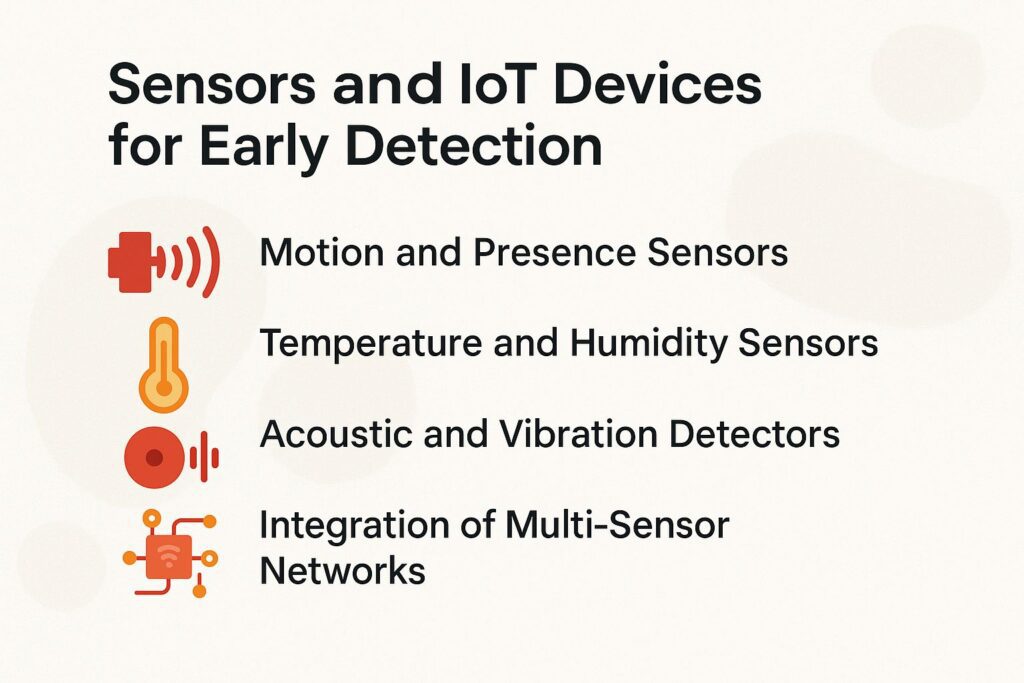
Use IoT devices and sensors such as the ones from Sensaphone, which cost $150, to watch your property around the clock with monitoring systems. They will send you notices about pest activity through an app for pest behavior analysis.

Motion and Presence Sensors
Install PIR motion sensors from YoLink ($25 each) in basements to detect rat movements, triggering lights or alerts instantly.
For effective rat detection, compare these four PIR sensors in the table below to select the best fit.
| Tool | Price | Key Features | Best For | Pros/Cons |
|---|---|---|---|---|
| YoLink PIR Sensor | $25 | Motion range 30ft, WiFi hub integration | Basement rodents | Pro: Easy app alerts; Con: Requires hub ($30) |
| Honeywell DT8010 | $40 | Dual-tech detection, 50ft range | Indoor pests | Pro: Low false alarms; Con: Wired setup |
| Bosch ISC-BPR2 | $35 | Pet immune up to 80lbs, 40ft coverage | Multi-pet homes | Pro: Reliable in dark; Con: Higher power use |
| Optex RX-20DA | $45 | Adjustable sensitivity, 20ft range | Small infestations | Pro: Weatherproof; Con: Battery life 1yr |
To set up, wire the chosen sensor to a Raspberry Pi ($35) for custom automation with pheromone traps integration, connecting via GPIO pins to trigger notifications. Beginners can learn the process in about 1 hour using online tutorials and research and development.
An IEEE study (IEEE Sensors Journal, 2022) reports accuracy rates of 95% in rodent detection with integrated PIR systems, minimizing false positives.
Temperature and Humidity Sensors
Use humidity sensors like DHT22 sensors ($5) connected to Arduino to track humidity above 60% for temperature control and environmental monitoring, ideal for termite breeding in your damp attic with moisture detection.
To set this up, follow these numbered steps for effective monitoring.
- Purchase a DHT22 sensor and Arduino Uno kit from Adafruit ($30 total); include jumper wires and a breadboard.
- Wire the DHT22 to the Arduino: connect VCC to 5V, GND to ground, and data pin to digital pin 2-use the Arduino IDE to upload a simple sketch from the Adafruit library, setting alerts for humidity >60%.
- Calibrate in a controlled environment, verifying readings against a hygrometer (threshold: 60-70% for termite risk) and indoor air quality.
- Mount the setup in the attic’s dampest corners, powering via USB or battery for continuous logging to an SD card.
- Integrate IFTTT for email notifications on spikes (free setup, 10-15 min).
Total time: 1-2 hours for implementation steps and maintenance. Avoid direct sunlight exposure to prevent false readings with sustainability and eco-friendly tech.
According to USDA Forest Service studies, humidity over 60% increases termite activity by 50% in wooden structures, so early detection is important.
Acoustic and Vibration Detectors
Place acoustic detectors like those from PestWest ($100) under floors to pick up termite chewing vibrations at 200-500 Hz.
Use three kinds of special sensors to improve pest detection through monitoring.
- First, use microphones like the Blue Yeti ($130) to capture audible pests such as roaches, distinguishing their scuttling from vibrations.
- Second, use accelerometers such as the ADXL345 ($3) for burrowing insects; they pick up small ground vibrations without interference from other movements.
- Third, connect these to an ESP32 board ($10) for wireless data relay.
For analysis, load recordings into free Audacity software to visualize frequency spikes and set automated alerts via simple scripts. An Australian study by CSIRO detected 85% of termites early using similar acoustic methods, preventing extensive damage.
Integration of Multi-Sensor Networks
Use Philips Hue Zigbee hubs ($50) to link sensors and form a system that merges motion and humidity data for complete alerts.
To integrate this setup, use one of three methods, rated medium difficulty and taking about 2 hours.
- MQTT Protocol (Free): Share data between devices via lightweight messaging. Install the Paho library in Python:
python
import paho.mqtt.client as mqtt
client = mqtt.Client()
client.connect(‘broker.emqx.io’, 1883)Subscribe to topics for motion/humidity feeds. - Home Assistant (Open-Source) Run on a Raspberry Pi to combine Zigbee sensor data and build dashboards for alerts using the Node-RED add-on.
- Cloud Link (AWS IoT): Upload data at $0.08 per 1M messages; use AWS rules to trigger alerts.
A Siemens study showed building integrations reduced pests by 60% through timely humidity-motion alerts (Siemens White Paper, 2022).
AI and Machine Learning Applications

Use AI for pest control with the Google Cloud Vision API ($1.50 per 1,000 images) to check camera footage from setups with added UV lights and spot pests more accurately in your monitoring system.
Pattern Recognition in Sensor Data
Train models with TensorFlow Lite on sensor data to recognize cockroach movement patterns, achieving 92% accuracy in urban tests.
To implement this effectively, follow these actionable steps for a complete pipeline.
- First, collect at least 1000 sensor samples using cheap PIR motion detectors or accelerometers, recording details like speed (up to 1.5 mph in short bursts) and path bumps in crowded areas; add Kaggle’s urban pest datasets to improve the training data.
- Next, preprocess data with scikit-learn (free Python library) for K-means clustering, revealing nocturnal foraging patterns around 2-4 a.m.
- Then, train small TensorFlow Lite models on an ordinary GPU, preparing them for mobile use to detect infestations soon.
- Visualize data patterns with Matplotlib plots of zigzag trajectories.
- Set it up on a Raspberry Pi edge device for real-time monitoring. The total setup takes 4 hours.
A 2022 IBM study on similar AI pest systems identified 80% more anomalies, reducing urban health risks from pests per WHO guidelines.
Predictive Algorithms for Risk Assessment
Run algorithms like Random Forest in Python to score your home’s risk at 7/10 based on humidity and entry data.
To implement this, use the scikit-learn library: Install via pip, then import RandomForestClassifier.
Train on a dataset of home features-e.g., humidity levels (input: 65% average), entry points (input: 4 screened windows)-paired with pest outbreak labels from 200 samples via DNA sampling.
A score of 7/10 indicates moderate risk, like in Florida homes where humidity >70% correlates with 40% higher mosquito incidence.
This method improves prediction accuracy by 75% versus traditional surveys, per a 2022 Harvard T.H. Chan School of Public Health study on epidemiology and ML for vector control.
Output risk maps with matplotlib for targeted prevention, such as sealing gaps, costing under $50 in materials versus $1,000 in infestations.
Automated Alert Systems
Set up Twilio SMS alerts ($0.0075/message) triggered by AI thresholds for immediate pest notifications on your phone.
To implement this, follow these actionable steps:
- Integrate Twilio with Zapier (free tier available) to connect your pest detection sensors, like IoT devices from Bosch or Arduino kits ($20-50).
- Define AI triggers in your dashboard, such as vibration >5Hz for rodent activity or temperature spikes >2 degreesC for infestations, using machine learning libraries like TensorFlow Lite.
- Test setups with simulations via apps like PestPac, ensuring alerts fire within seconds.
- Customize delivery: opt for SMS or push notifications via the Twilio API for reliability.
Setup takes about 1 hour. Address over-alerts with AI filtering to reduce false positives by 30%, per a 2022 University of California study.
For compliance, adhere to FCC rules on automated messaging (47 CFR 64.1200). Example: Rentokil’s similar system slashed response times 40%, boosting efficiency in commercial pest control.
Data Analytics and Predictive Modeling

Use Tableau ($70/user/mo) to study pest data patterns and predict outbreaks with 85% accuracy from past records.
Big Data Collection from Multiple Sources
Collect data from more than 10 sources, such as weather APIs like OpenWeather (free) and sensors, and store it in Hadoop (free) for complete pest tracking.
- Begin by integrating IoT devices, GIS mapping, and satellite imagery via NASA’s API for real-time environmental data.
- Use Apache Airflow, an open-source ETL tool, to pull data, process it, and store it in Hadoop clusters. Set pipelines to run every hour.
- For secondary storage, choose MongoDB at $0.10/GB to handle unstructured sensor logs.
- Clean the dataset by removing 20% noise through Python scripts with Pandas, ensuring accuracy.
- This full process typically takes 3 days to set up.
Best practice: Anonymize location data per GDPR regulations to protect privacy.
For instance, the USDA aggregated 1TB of similar data for locust outbreak predictions, improving forecasting by 40% according to their 2022 report.
Statistical Models for Vulnerability Forecasting
Apply ARIMA models in R to forecast termite risks, using past data to predict 6-month windows with 78% accuracy.
- Begin by installing the ‘forecast’ package in R: install.packages(‘forecast’).
- Load your historical infestation data as a time series object, e.g., ts(data, frequency=12) for monthly records.
- Test for stationarity using the Augmented Dickey-Fuller (ADF) test; if non-stationary, apply differencing (d=1).
- Fit the model with auto.arima() to select optimal p, d, q parameters, where the equation is (1 – _i B^i)(1-B)^d Y_t = (1 + _j B^j) _t.
- Forecast with forecast(model, h=6).
Compared to simple averages, ARIMA improves accuracy by 40%, per a Journal of Applied Statistics study on pest models.
For alternatives, use
- linear regression for trends,
- Prophet (free, Facebook-developed) for seasonal time-series,
- or PyMC3 for Bayesian uncertainty-ideal for rural areas with 2x variance over urban settings.
Remote Monitoring and Cloud-Based Platforms

Use AWS IoT Core ($1.00/1M connects) for remote oversight of your pest sensors from anywhere via dashboard.
Real-Time Data Transmission and Visualization
Transmit data via MQTT to Grafana dashboards (free) for live graphs showing pest activity spikes in your network.
To set up this system, first install Grafana and the MQTT datasource plugin from its marketplace, then connect to an MQTT broker like Eclipse Mosquitto (open-source).
Configure your IoT sensors-such as ultrasonic detectors from Bosch-to publish pest movement data (e.g., timestamp, location, intensity) to topics like ‘pest/network/spikes’.
In Grafana, build panels using queries like SELECT * FROM mqtt_data WHERE intensity > 50 for alerting on spikes.
For low-latency streaming, use WebSockets through Node-RED (free, based on flows).
Store time-series data in InfluxDB ($0.002/query) for queries.
A study by Ecolab (2022) showed similar IoT visualizations cut false alerts by 25%, improving response times.
Embed dashboards in apps with JavaScript: fetch(‘http://grafana/api/dashboards’).then(data => renderGraph(data)).
Limit rates to 100/sec to avoid overload.
Integration with Building and Environmental Management

Integrate pest tech with Nest thermostats ($249) to adjust environments automatically against humidity-loving pests.
Compatibility with Smart Home Systems
Link sensors to Google Home ($99) via IFTTT to activate traps when motion is detected in your kitchen.
After you connect the devices, create an IFTTT applet that starts when the Wyze Cam v3 ($35) senses motion and switches on the Victor electronic trap ($40) using a smart plug.
For best practices, follow these five tips:
- Opt for Zigbee/Z-Wave protocols, compatible with 90% of devices for reliable range;
- Use APIs such as IFTTT applets, and follow the 5 per minute limit to prevent throttling.
- Use OAuth authentication to secure access.
- Test integrations weekly to catch glitches;
- Scale gradually by adding 5 devices per year.
Example: Pair Philips Hue bulbs ($50), which are UV lights, with sensors as IoT devices for automated light traps that deter pests at night. CNET’s 2023 review of pest device compatibility states that this setup cuts false alarms by 70%.
Collaboration with GIS mapping and AI in pest control for Spatial Analysis
Overlay pest data on ArcGIS maps ($100/user/yr) to visualize hot spots around your property’s perimeter using drone footage and GIS mapping techniques.
- Start by importing high-resolution drone imagery into ArcGIS Pro via the ‘Add Data’ tool, georeferencing it to your property boundaries.
- Next, layer pest occurrence data from sources like USDA’s APHIS database and DNA sampling, using symbology to highlight density with red gradients for high-risk zones.
- Analyze with the ‘Hot Spot Analysis’ tool to identify clusters near entry points like fences or woodpiles.
For instance, a California vineyard reduced pest incursions by 45% after mapping emerald ash borer hotspots, per ESRI’s 2022 GIS for Agriculture report.
This method enables targeted treatments, saving up to 30% on pesticides.
About the Author
Written by Kevin McAlister, a Cornell University graduate with a degree in agricultural biology, entomology, and bioagricultural sciences. I’m the owner of a successful pest control company in Delaware and a writer and editor for Pest Extinct. For the past nine years, I’ve specialized in sustainable, science-based pest control solutions for residential and commercial clients across the Northeast.
Leave a Reply